Teaching
“Above all else, teaching appeals to me because I love being in the classroom. Perhaps it comes from my training as a concert pianist, but I find teaching thrilling: the performance, the back-and-forth, the exhilaration of learning with others.”
Read Joel's full teaching philosophy
My experience teaching in a variety of disciplines and institutions has taught me a number of pedagogical lessons. First of all, I take a developmental view of learning. I structure all of my courses around incremental assignments that build from basic skills of analysis to more advanced critical thinking, thus teaching thinking through staged writing and reflection. In the introductory level courses I taught at Carleton, for example, students first interpreted difficult arguments; then analyzed and criticized these arguments; then created their own arguments. At each stage I used peer revision to focus on particular aspects of academic writing: introductions, the use of evidence, and conclusions. By the end of the course, students had moved from struggling to understand the claims of a text to advancing their own arguments in conversation with other authors, both the authors we had read and their fellow authors in the class.
Alongside my developmental view of learning, my experience teaching has also shown me the crucial role of questions as tools for developing learning. I frame all of my courses with “big questions” – about justice or political life or freedom – that grab students’ attention and sustain it throughout the semester. On the first day of class I tell students that these questions have challenged writers and thinkers for millennia and that in this class they will join a community of inquiry spanning these many centuries. Once they view their own writing as part of a conversation about big questions, students recognize the meaningfulness of their work and pursue creative answers. No longer do they write mere “papers,” but “essays” that attempt to say something new and significant about important matters of concern. In my upper-level courses students write critical review that enter conversations with significant contemporary political thinkers such as Charles Taylor or Bonnie Honig or Jürgen Habermas. By placing students in a lively and momentous conversation about political life today, our work together in the course gains meaning and importance. The “big questions” of today create spaces for developing learning while giving students stakes for their activities.
These questions also give an urgency to my courses that heightens the engaged learning I seek to develop in my students. By “engaged learning” I mean connecting what we learn and do in the classroom to students’ preconceptions and their daily interaction with the world around them (their “mental models”). I often do this by introducing material with film clips, images, or recent newspaper articles. In my “The Future of Democracy” course at Deep Springs, for example, students took turns presenting “Democracy in the News,” introducing and then discussing how democracy had appeared in current events and beginning to analyze these events with the theoretical lenses we had developed during the course. In this way, students practice connecting academics to “the real world” and begin to see how our theoretical inquiries lead them to see this world differently, appreciating its complexity and gaining confidence about how to understand this complexity. In all of my courses, while students work with texts and rhetorical styles ranging from the fourth century BCE to the twenty-first century today, I seek to bring the study of the history of political thought to the urgent political realities around them.
These examples of engaged learning also illuminate how teaching translates to my own work. My research begins from a deep concern with democratic life today, a concern that I seek to explore through a dialogue between past and present. One challenge of my research lies in finding points of contact where I can bring modern concerns into conversation with historical thinking. With this challenge in mind, I design my courses such that students are put in a position to explore creative juxtapositions in their own writing, allowing me to enlist them in the brainstorming process that forms a large part of my own work. Even at the most basic level of interpreting a particular text, students inevitably discover new insights when they pore over arguments I once regarded as familiar. In one course at Duke, I assigned students three different translations of Plato’s Republic and in class sessions we often closely compare how subtle turns of phrase among these translations change the apparent meaning of the text. While I have read the Republic in Greek multiple times, these variations reminded me – and I impressed upon the students – that every reading constitutes a translation, a fact that my own proximity to the text had elided. As I seek to use these texts in my own work, teaching them to thoughtful and responsive students enlivens their ambiguities anew.
Above all else, teaching appeals to me because I love being in the classroom. Perhaps it comes from my training as a concert pianist, but I find teaching thrilling: the performance, the back-and-forth, the exhilaration of learning with others. I often think of an orchestra conductor when I teach. The conductor must bring her ensemble to the best possible performance but she cannot pick up her violin and do it herself; she must somehow speak to the soul of each musician and find within each some source of inspiration. Working with undergraduate students also means initiating them into this wonderful aspect of university study. Teaching thus gives me the opportunity to continue the music-making of a teaching life.
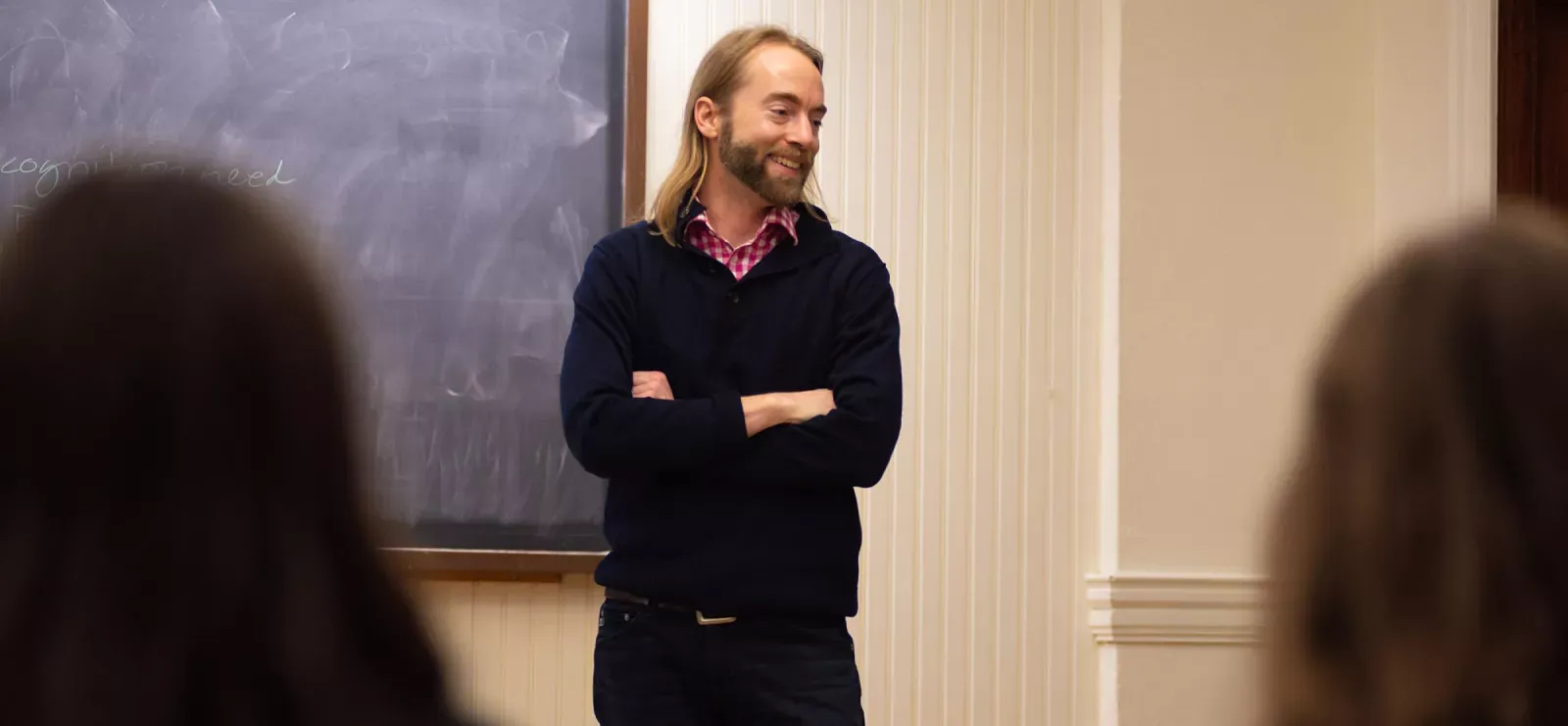
In all of his courses, Joel connects questions from contemporary politics with the history of political thought: Greek tragedy and the Hollywood Western, Hegel and contemporary identity politics, international relations and Herodotus.
He received Bryn Mawr's Rosalyn R. Schwartz Award for Teaching in 2018, and his teaching at Deep Springs College was featured in the CNN Films documentary Ivory Tower. The American Political Science Association interviewed him about his teaching in 2019.
Bryn Mawr College
Underlined semesters open the syllabus.
- Governing the Self and OthersFall 2025 syllabus for Governing the Self and OthersFall 2024 syllabus for Governing the Self and OthersSpring 2022 syllabus for Governing the Self and Others
- Introduction to Modern Political PhilosophyFall 2025 syllabus for Introduction to Modern Political PhilosophyFall 2018 syllabus for Introduction to Modern Political PhilosophySpring 2016
- Friendship, Virtue, and Democratic PracticeSpring 2025 syllabus for Friendship, Virtue, and Democratic PracticeSpring 2021
- Introduction to Ancient and Early Modern Political PhilosophySpring 2025 syllabus for Introduction to Ancient and Early Modern Political PhilosophyFall 2020 syllabus for Introduction to Ancient and Early Modern Political PhilosophySpring 2018 syllabus for Introduction to Ancient and Early Modern Political PhilosophyFall 2015
- How to Do NothingFall 2024 syllabus for How to Do NothingFall 2021 syllabus for How to Do Nothing
- Freedom in the 21st CenturySpring 2024 syllabus for Freedom in the 21st Century
- Community and the Politics of PlaceFall 2023 syllabus for Community and the Politics of Place
- On the Human Condition: Hannah Arendt and Political ThinkingSpring 2023 syllabus for On the Human Condition: Hannah Arendt and Political ThinkingSpring 2015 syllabus for On the Human Condition: Hannah Arendt and Political Thinking
- The Power of the People: Democratic Theory and PracticeFall 2021 syllabus for The Power of the People: Democratic Theory and PracticeSpring 2016
- Anti-Political Theory and Radical StudyFall 2020 syllabus for Anti-Political Theory and Radical Study
- Do You Feel Lucky? Luck, Ethics, and PoliticsFall 2018 syllabus for Do You Feel Lucky? Luck, Ethics, and Politics
- Power and Resistance: Domination, Oppression, and the Arts of ResistanceSpring 2018 syllabus for Power and Resistance: Domination, Oppression, and the Arts of ResistanceSpring 2015
- Refusal, Resistance, and RebellionFall 2017 syllabus for Refusal, Resistance, and Rebellion
- Topics in Political Philosophy: JusticeFall 2017 syllabus for Topics in Political Philosophy: Justice
- Arts of FreedomFall 2015
- Freedom and the State: Modern Political PhilosophyFall 2014 syllabus for Freedom and the State: Modern Political Philosophy
Deep Springs, Outer Coast, and Tidelines22 courses
- Community and the Politics of PlaceSummer 2025 syllabus for Community and the Politics of Place
- Governing the Self and OthersSummer 2024 syllabus for Governing the Self and OthersSummer 2023 syllabus for Governing the Self and Others
- How to Have a LifeSummer 2023 syllabus for How to Have a Life
- How to Do NothingSummer 2022 syllabus for How to Do Nothing
- Going on Together in the Anthropocene (Deep Springs)Summer 2021 syllabus for Going on Together in the Anthropocene
- Living a Democratic Life (Outer Coast)Summer 2020 syllabus for Living a Democratic Life
- Politics, Markets, and Theories of CapitalismWinter 2014
- Public SpeakingWinter 2014 syllabus for Public SpeakingWinter 2013 syllabus for Public Speaking
- Hegel and the Politics of RecognitionWinter 2014 syllabus for Hegel and the Politics of RecognitionFall 2011 syllabus for Hegel and the Politics of Recognition
- Domination, Oppression, and the Arts of ResistanceFall 2013 syllabus for Domination, Oppression, and the Arts of Resistance
- Herodotus, Storytelling, and the Politics of HistoryFall 2013 syllabus for Herodotus, Storytelling, and the Politics of History
- Political Theory After Marx: Critical Theory Past and PresentSummer 2013 syllabus for Political Theory After Marx: Critical Theory Past and Present
- Antigone: Feminism, Tragedy, PoliticsWinter 2013 syllabus for Antigone: Feminism, Tragedy, Politics
- Freedom and the State in Modern Political TheoryWinter 2013 syllabus for Freedom and the State in Modern Political TheoryFall 2010 syllabus for Freedom and the State in Modern Political Theory
- Foundings and Refoundings: Memory, Tradition, and Political IdentitySummer 2012 syllabus for Foundings and Refoundings: Memory, Tradition, and Political Identity
- The Future of DemocracyWinter 2012 syllabus for The Future of Democracy
- Arendt and her Interlocutors: On The Human ConditionWinter 2012 syllabus for Arendt and her Interlocutors: On The Human Condition
- Liberalism and its discontents: Individual and Community in Modern Political ThoughtFall 2011 syllabus for Liberalism and its discontents: Individual and Community in Modern Political Thought
- Heidegger: Philosophy and PoliticsFall 2011 syllabus for Heidegger: Philosophy and Politics
- Political Theory After Marx: Critical Theory and PostmodernismWinter 2011 syllabus for Political Theory After Marx: Critical Theory and Postmodernism
- Justice Among Nations in Thucydides and HerodotusWinter 2011 syllabus for Justice Among Nations in Thucydides and Herodotus
- Tragedy and Politics: Greek Tragedy and the Hollywood WesternFall 2010 syllabus for Tragedy and Politics: Greek Tragedy and the Hollywood Western
Carleton College5 courses
- POSC 160: Introduction to Political PhilosophySpring 2010 syllabus for POSC 160: Introduction to Political PhilosophySpring 2008 syllabus for POSC 160: Introduction to Political PhilosophyWinter 2008 syllabus for POSC 160: Introduction to Political Philosophy
- POSC 252: Justice Among Nations (Thucydides and Herodotus)Spring 2010 syllabus for POSC 252: Justice Among Nations (Thucydides and Herodotus)
- POSC 251: Modern Political PhilosophyWinter 2010 syllabus for POSC 251: Modern Political Philosophy
- POSC 272: American Constitutional Law IISpring 2008 syllabus for POSC 272: American Constitutional Law II
- POSC 271: American Constitutional Law IWinter 2008 syllabus for POSC 271: American Constitutional Law I
Duke University2 courses
- WRITING 20: Living Justly in an Unkind WorldFall 2009 syllabus for WRITING 20: Living Justly in an Unkind World
- POLSCI 123: Introduction to Political PhilosophySummer 2007 syllabus for POLSCI 123: Introduction to Political Philosophy